Main menu
You are here
Isocratic Profiles: Sun Yat-sen, Founder of Modern China
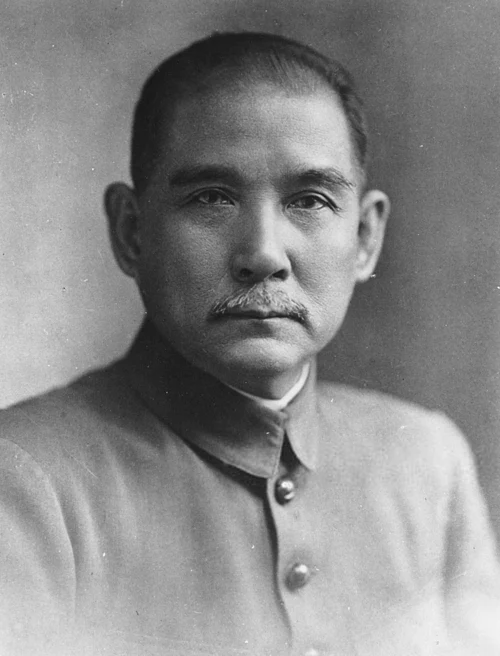 The following is an elaboration of a speech given at the 160th memorial of Dr Sun Yat-sen's birth, held in Melbourne, on November 7th, 2026.
I wish to express my sincere gratitude to Arthur Wu of the Melbourne Hung Mun Minzhi Party (which many will know as the Chinese Masonic Society) for this opportunity to speak here at Dr Sun Yixian's monument outside the Chinese Museum, in Melbourne on the 160th anniversary of Dr Sun's birth. It is an extraordinary honour for a person like myself, with no known Chinese heritage, to be given this opportunity, and it is one for which I am very grateful. I do take this opportunity to mention, however, that Dr Sun’s social and political theory has been very influential in the development of my own thought on these matters.
I will mention that I am speaking here as the representative of the Australia-China Friendship Society, an organisation now in its 75th year of operations. Whilst it is an objective of the Society to promote mutual understanding between Australia and China, which certainly includes understanding of Dr Sun, I present the following words in a personal capacity.
It is quite a tragedy that Dr Sun Yixian, better known outside China as Dr Sun Yat-sen, is a relatively obscure figure, except in the People's Republic of China, in the final province of the Republic of China, and among many Chinese communities worldwide. Of course, among those people, he is appropriately revered, attracting honourific titles such as "Father of the Nation", "Great Pioneer of the Democratic Revolution", and "Forerunner of the Revolution". Outside of these communities, and among the few people who have an interest in Chinese history, Dr Sun is a relatively unknown figure, which is unfortunate given his enormous life achievements that he carried out with a dedicated and intrinsic emotional commitment to the Chinese people and a rational commitment to universal principles of humanity and reason.
The basic facts are readily available: in the late 19th and early 20th centuries, Dr Sun was born into a poor peasant family but received an education in Hawaii and graduated from the Hong Kong College of Medicine for Chinese. He submitted a petition to reform the Qing dynasty in 1894, but when it was rejected, he went into exile and founded the Revive China Society, the Tongmenghui, and the newspaper People's News. These bodies would eventually become the Kuomintang, and Dr Sun would become the inaugural premier of this body, whose establishment followed the 1911 revolution that overthrew the Qing dynasty; Dr Sun is seen as the leader and proclaimed the Republic of China. Dr Sun then became the president of the Provisional Government of the Republic of China in 1912.
The initial period was extremely difficult for the republic; however, the second president of the republic, Yuan Shikai, in his pursuit of grandeur, first organised the assassination of the constitutional parliamentary leader Song Jiaoren, then declared himself Emperor of China, and died the following year after a three-month reign. Dr Sun led a second revolution against this usurpation of power, but this was defeated. Shortly afterwards, in 1917, as the country was increasingly controlled by local warlords, Sun established the Constitutional Protection junta in Guangzhou and took over leadership in 1921, with support from the new Soviet Union and the Chinese Communist Party, forming the First United Front. In his final years, before dying of gallbladder cancer in 1925, he continued his campaigns against warlords and delivered several important speeches, including the famous "Three Principles of the People" and the "Five-Yuan Constitution" on the political system and bureaucracy.
It is important to realise that, above all else, Dr Sun was a modernist, in both the technological and political senses. Technologically, this is evident in his "The International Development of China" (1920), an outstanding work of economic geography which advocated a whole-country adoption of new technology and infrastructure, including railway networks, seaports and shipping, electrification, industrialised agriculture, irrigation networks, and natural resource extraction. As a political modernist, he was an advocate of secularism, with a consistent advocacy of the separation of church and state, freedom of religion, equality of religions, and that religion should not interfere in politics, all of which would be included in constitutional and legal documents. Notably, he did so even though he was personally a Christian.
Dr Sun's political modernism also meant that he became a republican. Whilst it might seem obvious from his political activities, the tense "became" is very important; initially he attempted to appeal to the Qing dynasty for reform; arguably he would have been satisfied with a modern constitutional monarchy. But when that autocratic, dynastic, absolutist, and ossified regime refused to entertain his suggestions, the die was cast. Reform, the process of gradual and incremental change, became impossible and, in that context, he also became a revolutionary, recognising the need to overthrow an old regime that was incapable of change and to introduce ground-breaking new technologies and systems that accorded with the new circumstances and consciousness of the time.
Dr Sun sought to introduce a rules-based order that respected civil rights and responsibilities; he was a constitutionalist, a liberal, and a democrat. This is strongly evident in the 1912 Provisional Constitution; it established equality among citizens without distinctions of race, class, or religion; it provided for personal security against arbitrary arrest and detention, and for the protection of the home against unlawful searches. It provided for security of personal property and freedom to trade, freedom of speech, writing, publication, assembly and association, confidentiality of correspondence, freedom of residence and movement, and freedom of religion.
It must be understood, however, that Dr Sun did not agree that these freedoms would be unqualified (nor did the 1912 constitution). As his famous Three Principles of the People make clear, China's national independence was seen as a prerequisite and a priority over individual liberty. Dr Sun was both a nationalist and an internationalist. He argued against the cultural cosmopolitans of his time, not because he felt they were wrong in principle, but because China was unable to properly promote its own culture whilst it was under the Unequal Treaties imposed by foreign powers. Only when China was independent could the country embrace other cultures on equal terms, and, as he made it quite clear in his speech on "Pan-Asianism", especially when there are common experiences of imposed imperialism.
Finally, it must be understood that Dr Sun was a socialist. Not only did he support public ownership of the commanding heights of the economy and infrastructure, but he was also absolutely dedicated to improving social welfare and, certainly, at the time he was writing, there was a lot to improve. Dr Sun was also deeply committed to the public acquisition of land rents for social benefits, an idea influenced by the American economist Henry George. There was also advocacy for the cooperative movement, especially consumer cooperatives, as well as agricultural and workers’ cooperatives.
There is one final matter to consider: Dr Sun's legacy in the current political climate. Based on the content available to us (which includes the political positions of his wife, Soong Ching-ling), it seems unlikely that he would have supported the split between the CCP and the KMT and that he would consider the separation of the PRC and the ROC to be one of the most profound failures of the modern revolutions; that is, the failure to achieve national unity. However, he would be deeply impressed by the extent to which national sovereignty, through science, technology, and industrialisation, has been achieved, along with a commitment to social welfare and common prosperity. China today is a world power, which is what Dr Sun believed it should be, but it has also reached this goal with a notable lack of imperialist exploitation or foreign interference. There is little doubt that he would want a united China, but with various and significant reforms; the rule of right, rather than might, must apply. After all, he always recognised the need for some variation in how different parts of China were governed. It is from these enduring principles of a unified China with diversity, independent of foreign influence, that Dr Sun's legacy, a person of great intelligence, compassion, and dedication to the welfare, unity, and progress of the Chinese people, using principles that apply to all people, can best be respected and honoured.
- Log in to post comments