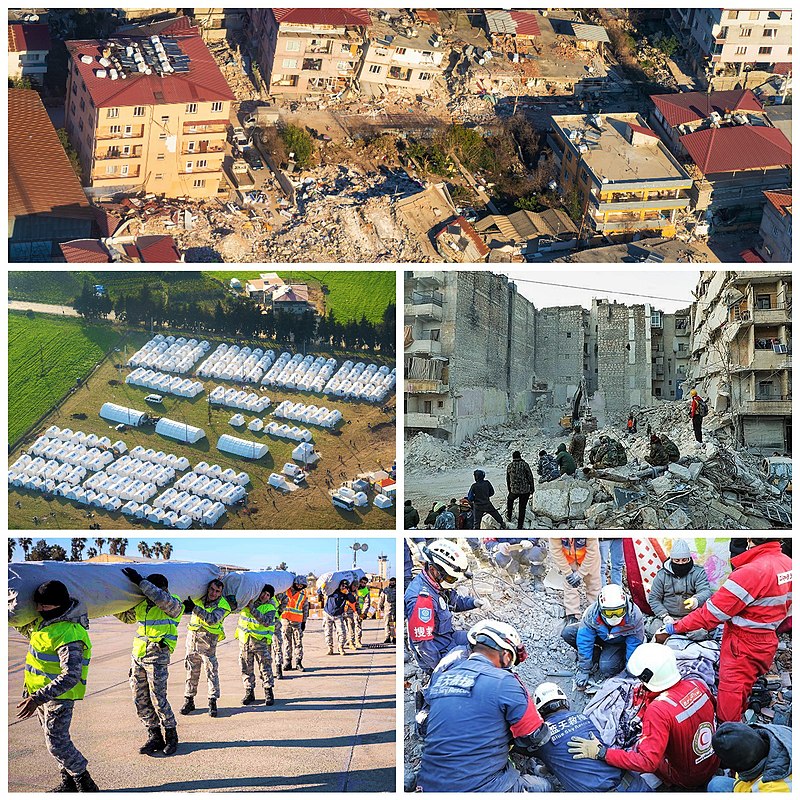
 This article is part of keeping up with the humanitarian and political consequences of the devastating earthquake that struck Syria and Turkey at the dawn of February 6th. I am writing this content more than three weeks after the earthquake in Syria and Turkey. Throughout these weeks, whenever I begged myself to sleep, a series of images, scenes, and moments I experienced during the earthquake in Turkey flashed through my head. Sometimes, they all overlap in my head at once, so I can't separate them, or suddenly one of them jumps out without the other, repeating itself dozens of times. In some of them, faces and people are absent and their voice remains, or their voice is absent and their images remain, and in others, voices and faces are cut off. And in miserable times I tried to deceive the cruelest of them to beautify it, to banish it, to make it only a nightmare, and I failed, got up, and had a severe headache.
Will I die today?
The place: a small room in an old house consisting of three floors in the Mazrlik neighborhood in Antakya. The time: at dawn on Monday, February 6, 2023, at 4.17 am.
My bed shakes, and I wake up, it's not a fleeting little shake that Antakya is used to from time to time, I tell myself. The tremor intensifies, it's an earthquake, I get it. I quickly stand under (the door lintel ) the door of my room, knowing in advance that standing under the doors is a safe place during an earthquake. The earth does not stop shaking and becomes more intense, so I rush out of my room towards (the yard) of the house in front of it, I fall, swaying right and left, with difficulty getting up, and the shaking becomes more violent, will I die today? I talk to myself, and my neighbor Fatima and her husband, who live on the first floor of the house, come to my mind. I scream" Fatima Fatima" I see her and her husband go out to the (yard) of the house, without covering her head screaming like crazy, then I see my neighbor, his wife, and two daughters who live on the second floor, and the young daughter of the owner of the Turkish house “Dilay” who lives on the third floor, they all go down to the yard of the house, all of us Fine, we hold each other and go out into the street, the ground is still shaking, we all stand up and I embrace Dilay.
 by Jon Hillström. There is a lot of incoherence many communists when it comes to the invasion and war in Ukraine. People will claim to be "anti-war", that they support neither Russia nor Ukraine then try to frame it as an inter-imperialist proxy war despite the fact that it was directly caused by Russia's unilateral decision to invade. Often enough the same people will (1) oppose any and all sanctions on trade with Russia and (2) oppose supplying any arms or equipment to Ukraine.
 The monopolistic aspect of the land, where income is derived without a contribution to production, was a cause of great criticism from even pro-capitalist class economists such as Adam Smith, David Ricardo, John Stuart Mill, and Henry George, who (along with the socialists, obviously) would argue for rents to be public property. In more modern times attention has been drawn to the monopolistic profits derived from the various and increasingly important intellectual property rights, part of the trajectory identified in Daniel Bell's
  Presentation to the Melbourne Agnostics Group, May 13, 2023
 While it would be inaccurate to describe the past six months of the war in Ukraine as devolving into a total stalemate, what is undeniable is that the front lines have become very much fixed. It would be accurate though, to describe the present moment as one of abeyance. Russia's winter offensive, its attempt to seize all of the Donbas, has
  The Australian government has made the wrong decision
  The definition of when a person becomes an adult varies according to culture, history, and discipline. In the English language a sequence is derived from etymology; "adult", from the French "adulte", from the Latin "adultus" ("grown up"), the perfect passive participle of adolescō ("I grow up"), itself from "adolescentem", the accusative form of "adolescens", present participle of "adolēscere" ("to become adult, grow up"), from ad- ("to") + alēscere ("to grow or become nourished"). With the subjectivity of individual differences it should be an uncontroversial point that individuals mature physically and cognitively at different ages.
  Jiang Zemin, who died in late November, was arguably the most consequential Chinese leader of the post-Mao era. And at what feels like a pivotal moment for the People's Republic, it is worth considering why so many Chinese are looking back fondly on the Jiang era. And also what his rise and rule can reveal about power politics in China.
 Michael Haines has spent over 50 years working at senior levels across construction, manufacturing, and logistics. In 2011, he set up a not-for-profit to work with major companies across the property, construction, and facilities management sector, along with global technology providers, to develop a governance framework for the emerging Digital Built Environment. Its purpose is to reduce complexity, while maintaining privacy and security, to deliver better outcomes more quickly, at less cost, and with less risk.
  Reading the 2000 edition of James Lovelock’s book "Gaia, the practical science of planetary medicine" (Lovelock, 2000) one find they adopt and retain many of Lovelock's perspectives. The term "Gaia" is emotively loaded, and Lovelock had received some very biased coverage on when interviewed and when he was advocating for nuclear energy. The term "Gaia" itself can inspire mistaken impressions in many - myself included initially - as they might envisage a Greek goddess from which the name comes and dismiss it as a "New Age" delusion but it is not. Lovelock's Gaia is the most utilitarian description of our dynamic living Earth from a top-down perspective, a biogeophysical self-regulating super organism, not necessarily sentient or intelligent but the same could be said for the deluded species destroying it. "Delusion" is the nicest explanations for our idiotic (Parker, 2005) ecocidal actions.